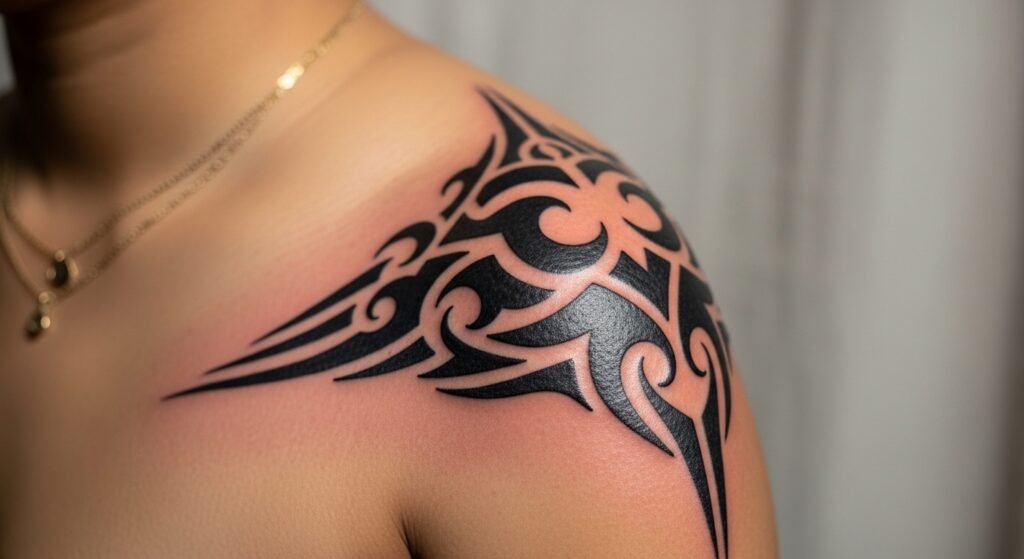
Sitting in a consultation room at 11:30 p.m., scrolling through saved pins and trying to describe the exact energy you want — that’s the place most of us are before committing to ink. If you've been thinking about a tribal shoulder cap tattoo for months, this list is built for that moment: clear visuals, real placement advice, and healing tips so your design looks as sharp years from now.
This guide walks you through 21 bold, culturally informed shoulder-cap designs: from heavy blackwork ancestral bands to delicate Polynesian-inspired motifs and modern geometric takes. You’ll find three designs that use the exact phrase tribal shoulder cap tattoo in their titles if you want keyword-matched inspo for searching or pitching ideas to an artist.
Prep and aftercare matter more than most people expect. I often suggest applying Zensa numbing cream 5% about 45–60 minutes before longer sessions, and leaving a Saniderm second-skin wrap on for the first few days helps protect linework while it settles. Scroll through these shoulder cap concepts, save the ones you love, and bring a couple of images to your consultation — it makes the conversation with your artist so much easier.
1. Classic Polynesian Shield — tribal shoulder cap tattoo
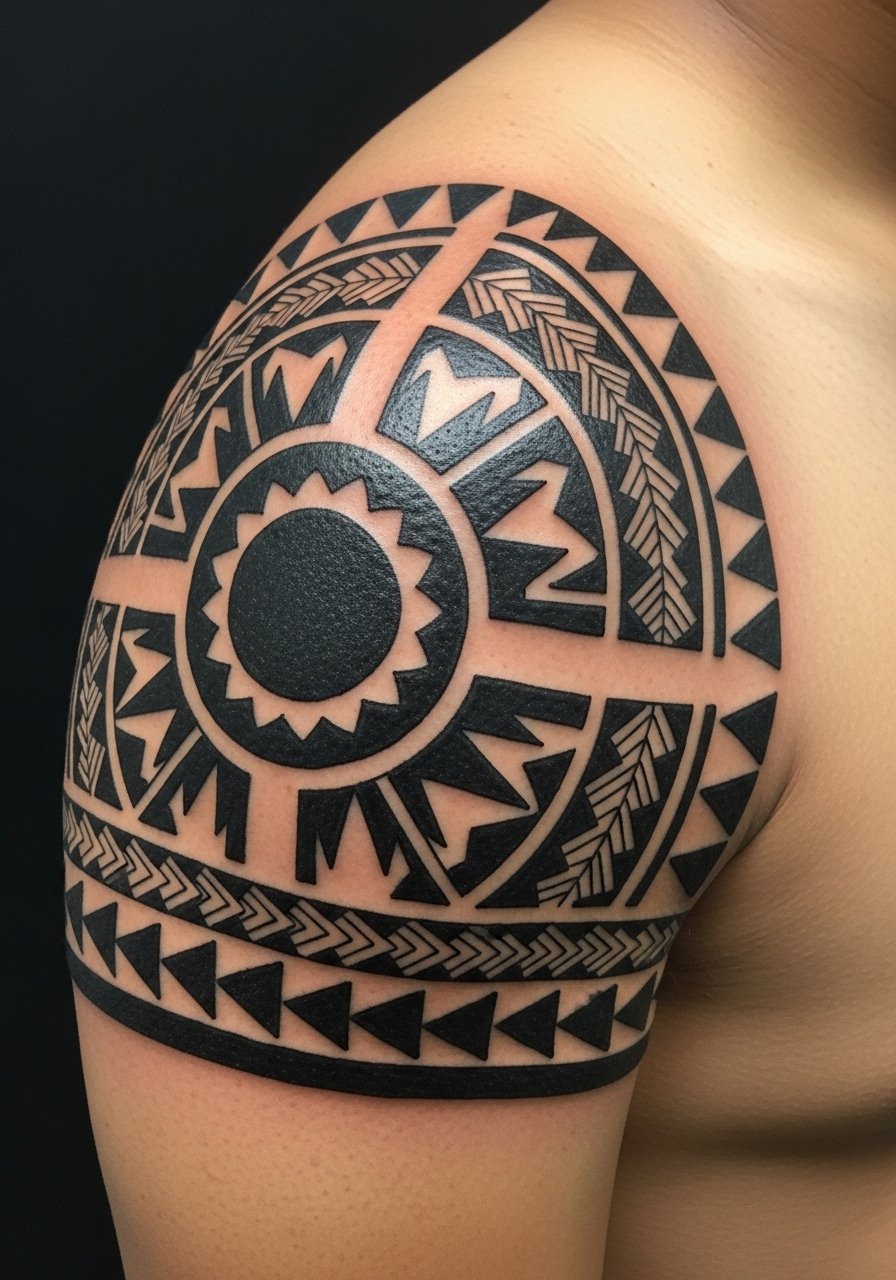
This design leans into traditional Polynesian geometry: thick bands, triangle teeth, and concentric shield elements that follow the shoulder’s natural curve. It reads powerful from a distance and holds intriguing detail up close. If you want something rooted in cultural motifs but sized for a single session, this is for you.
For session comfort on the shoulder cap, people sometimes use EMLA numbing cream beforehand for long blocks of solid blackwork.
Style & Design Details
- Tattoo style: blackwork, traditional Polynesian
- Recommended size: palm-sized to half shoulder cap (3–6 inches)
- Best placement(s): shoulder cap, upper deltoid, outer chest — follows rounded anatomy
- Color vs. blackwork: solid blackwork for contrast and longevity
- Design elements: repeated triangle “shark teeth”, concentric circles, solid filled bands, negative-space separators, radial symmetry
- Longevity note: solid black holds well; heavy fills can age into soft edges if over-shaded or placed too shallow
- Who it suits: darker and medium skin tones show strong contrast; great for collectors and those wanting cultural resonance
Finding the Right Artist
Look for portfolios with clean tribal blackwork and healed photos. Ask to see recent healed images to judge how dense fills settled. Ask your artist about stencil sizing and how they’ll contour pattern to your round shoulder. Avoid artists who only do light fine-line work — you want someone experienced with saturated black fills and consistent needle depth. Search Instagram tags like #polynesianblackwork and check local studio flash days.
Aftercare & Healing Tips
Leave a Saniderm wrap on for 2–4 days for heavy black fills, then switch to an unscented lotion like Lubriderm fragrance-free during peeling. Expect initial scabbing and plasma — don’t pick. For maintenance, a mineral SPF 50 tattoo stick every time the shoulder sees sun preserves the black. Touch-ups are common after the first 3–6 months for saturation adjustments.
2. Marquesan Band Wrap
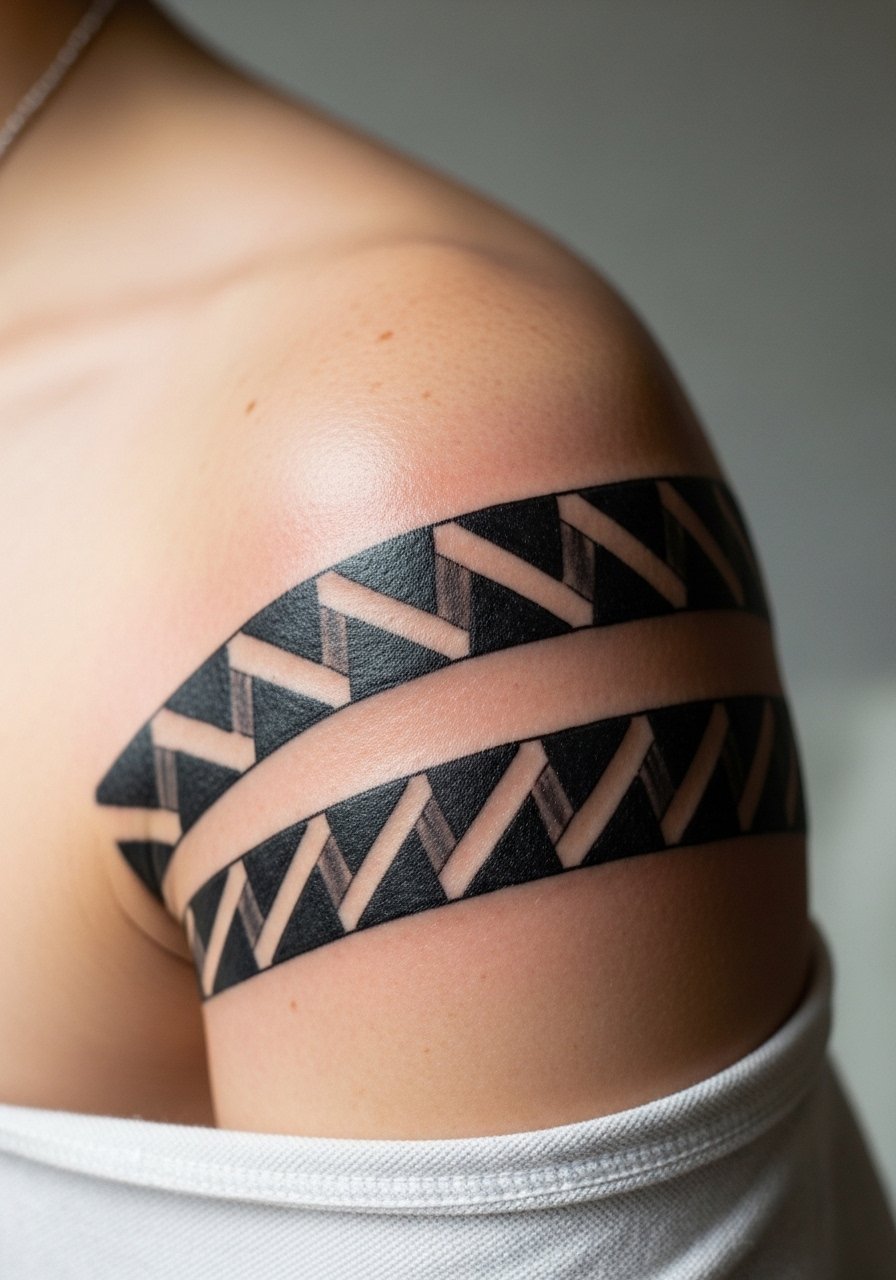
Marquesan motifs are known for their bold repetition and rhythm. This wrap uses alternating bands that hug the shoulder cap, creating a dynamic motion when you lift your arm. It’s graphic and reads like armor.
For stencil testing at home, try tattoo stencil transfer paper to visualize how the wrap moves with your shoulder.
Style & Design Details
- Tattoo style: blackwork, geometric
- Recommended size: quarter to half sleeve wrap (4–7 inches around the cap)
- Best placement(s): shoulder cap, upper arm, clavicle transition
- Color vs. blackwork: blackwork for clarity; tiny red accents possible but traditional use is black
- Design elements: chevrons, repeating bands, negative-space lines, rhythm-focused unit motifs, tapered ends that conform to shoulder curve
- Longevity note: pattern repetition helps disguise minor blur; keep out of direct sun
- Who it suits: people wanting bold silhouette tattoos that read at a distance
Finding the Right Artist
Seek artists with portfolio consistency in Polynesian and Marquesan styles. Ask about how they’ll scale motifs for your shoulder shape and whether they’ll adjust patterns over muscle curves. Avoid tattooers who can’t show matched pattern continuity on curved placements.
Aftercare & Healing Tips
Keep initial bandages undisturbed, then wash gently twice daily with a fragrance-free soap like Dr. Bronner’s unscented castile soap. After peeling, use an unscented lotion to prevent cracking; a thin layer of Hustle Butter Deluxe during weeks 2–4 soothes and conditions. Expect a 4–6 week full settle.
3. Sun-and-Wave Shoulder Cap — tribal shoulder cap tattoo
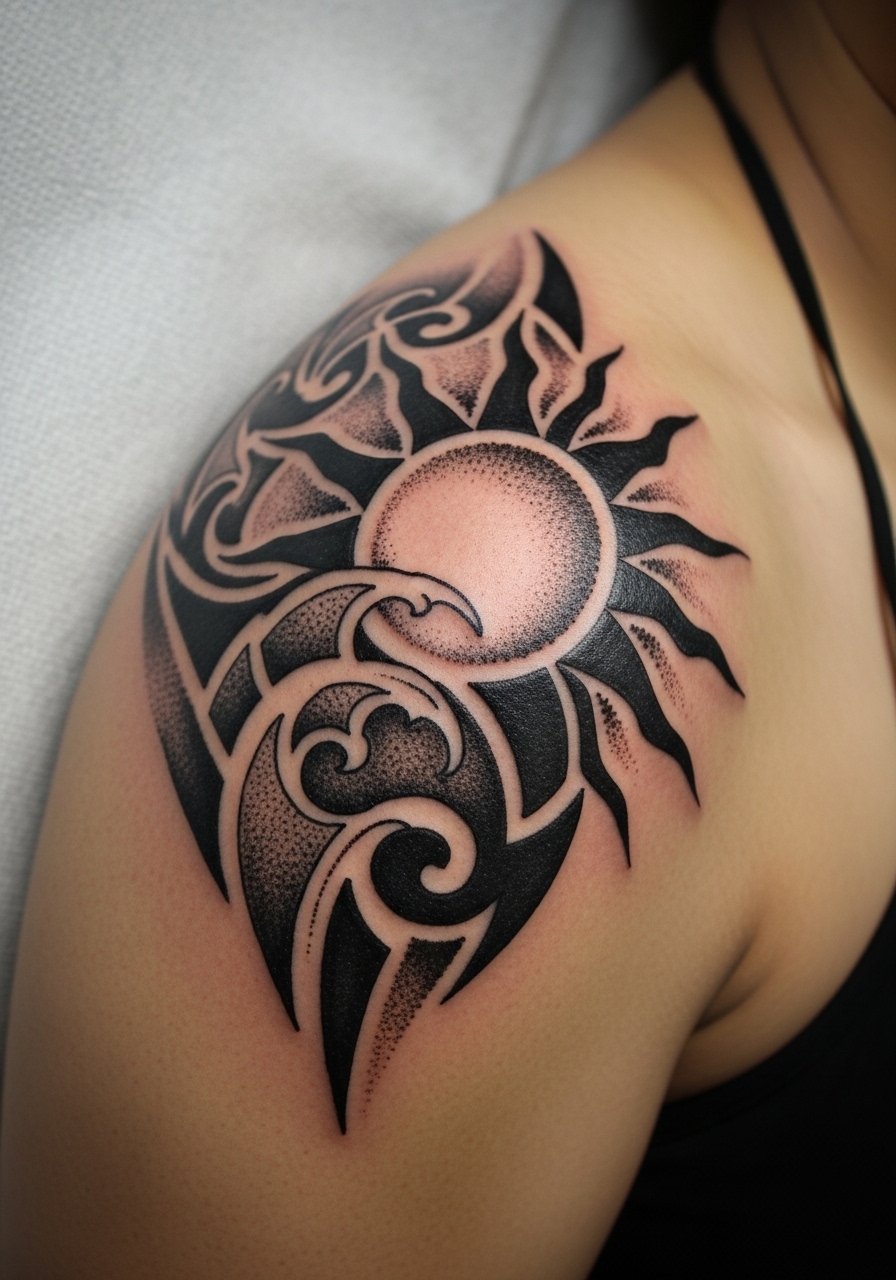
This motif pairs an abstract sun disk with flowing wave bands — a nod to islandic storytelling about guidance and travel. The sun sits near the shoulder peak, while wave bands cascade toward the arm, creating motion.
If you’re sensitive around the shoulder’s top near bone, applying Zensa numbing cream before long outlining helps.
Style & Design Details
- Tattoo style: blackwork with stipple shading
- Recommended size: 3–5 inches to preserve sun detail
- Best placement(s): outer shoulder cap, upper arm, near clavicle edge
- Color vs. blackwork: black and grey for soft gradients; small white-ink highlights optional
- Design elements: central sun disk, wave bands, stipple shading, radial lines, crescent negative spaces
- Longevity note: stipple fades faster than solid black; heavier contrast areas hold longer
- Who it suits: people who want symbolism (guidance, sea) with visual motion
Finding the Right Artist
Look for artists who show soft stipple and solid contrast in the same piece. Ask how they plan to balance stipple vs. solid so the sun remains readable years later. Avoid technicians who suggest heavy greywash over crisp linework for small sun details.
Aftercare & Healing Tips
Stipple work needs gentle handling; follow Saniderm for 48–72 hours, then wash with fragrance-free soap and moisturize with After Inked lotion. Use an SPF stick when exposed to sun to prevent early fading.
4. Haida-Inspired Shoulder Crest
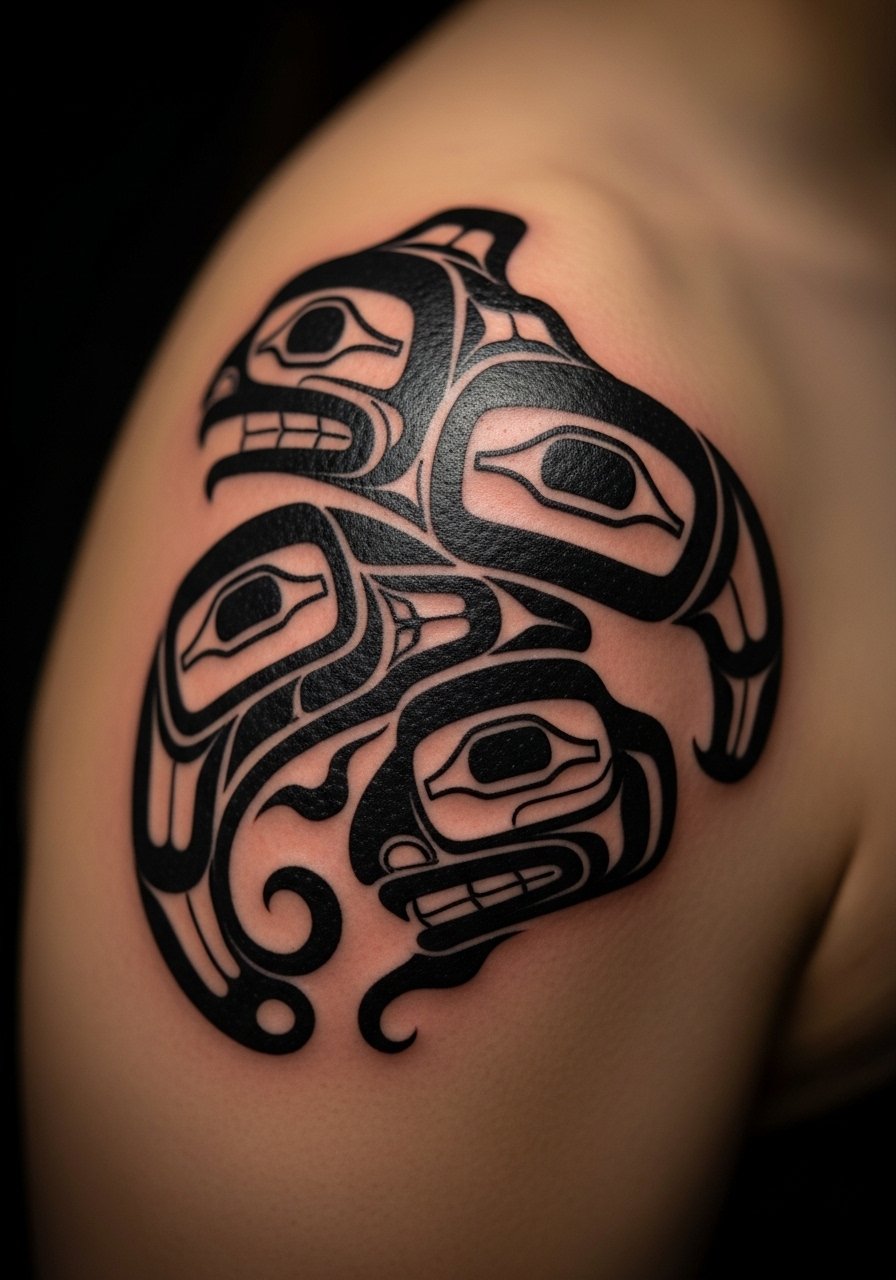
Haida motifs use faces, ovoids, and formline structure to tell lineage and story. A shoulder crest can incorporate a single crest figure, curving along the cap to read like a family emblem.
For reference creation, artists sometimes ask clients to bring visual references or draw with apps like Procreate on iPad to test layouts.
Style & Design Details
- Tattoo style: illustrative blackwork with cultural formline
- Recommended size: palm to half shoulder cap (3–6 inches)
- Best placement(s): shoulder cap, upper back, outer bicep
- Color vs. blackwork: solid black with negative space; limited red accents occasionally used
- Design elements: ovoids, formline curves, stylized faces, stacked shapes, flowing borders
- Longevity note: bold lines hold longest; tiny interior details may blur over decades
- Who it suits: people with respect for formline aesthetics and storytelling tattoos
Finding the Right Artist
This style requires someone who understands cultural lineage and the formal rules of formline. Ask how they'll approach cultural sensitivity and whether they’ve worked with indigenous styles responsibly. Avoid artists who replicate motifs without context or claim lineage they don’t have.
Aftercare & Healing Tips
Because bold outlines are central, keep scabbing minimal by following Saniderm for initial days and using a fragrance-free soap like Dial Gold antibacterial soap for washes. After peeling, use Hustle Butter Deluxe to keep lines supple.
5. Maori Koru Spiral Shoulder Cap
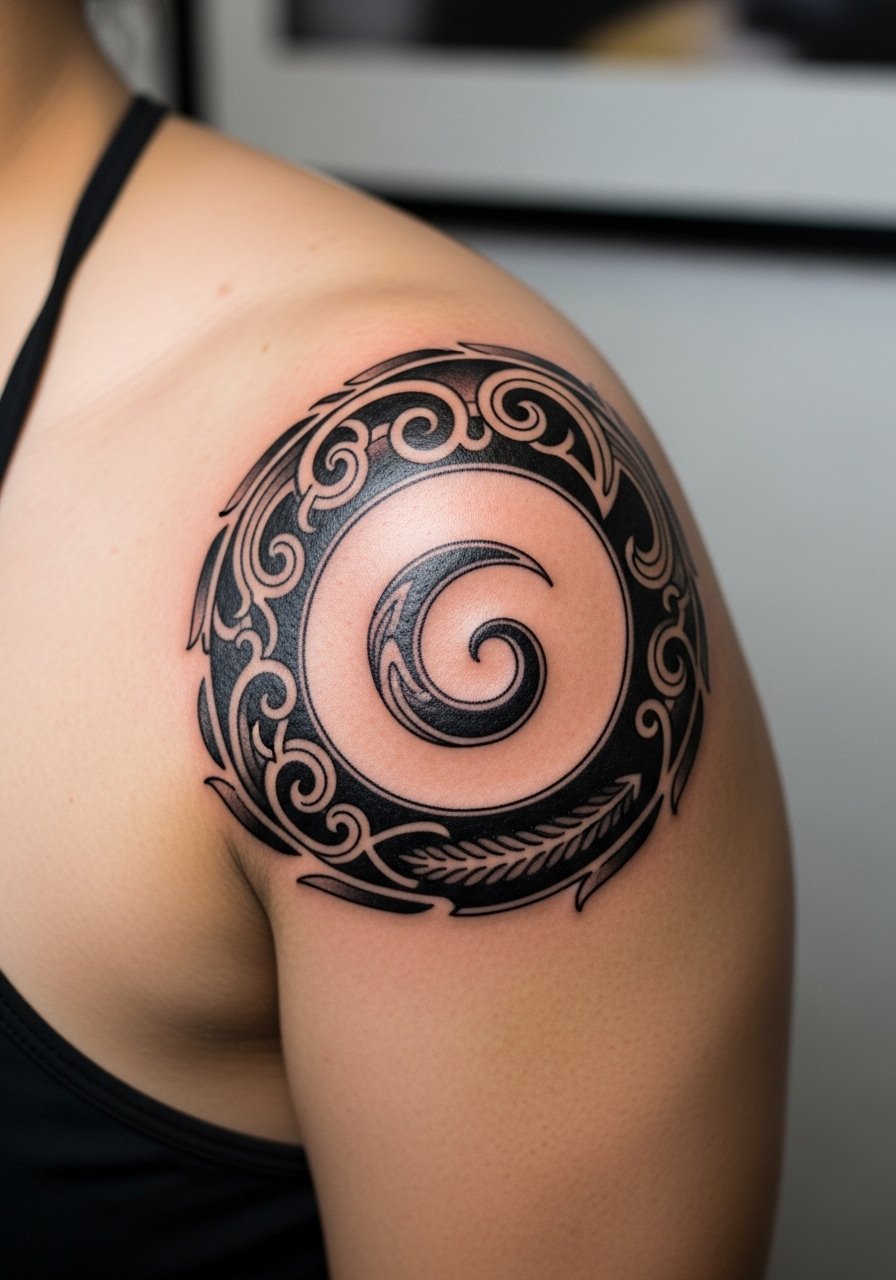
The koru spiral symbolizes new life and growth. A koru-based shoulder cap balances softness and strength, with curling elements radiating from the shoulder joint.
If you want to preview size, try a semi-permanent Inkbox kit to test placement for a few weeks.
Style & Design Details
- Tattoo style: blackwork with organic curl motifs
- Recommended size: 3–6 inches depending on spiral detail
- Best placement(s): shoulder cap, upper chest, near clavicle
- Color vs. blackwork: solid black for strong silhouette
- Design elements: large koru spiral, tapered rachis lines, small fern fronds, negative-space borders, curved symmetry
- Longevity note: bold shapes age well; keep out of sun for long life
- Who it suits: those who want balanced feminine/masculine flow with symbolic growth meaning
Finding the Right Artist
Look for artists who show clean curves and smooth tapering. Ask for healed photos of similar spirals to see how the taper lines settle. Avoid artists who rely solely on machine shading for crisp koru shapes.
Aftercare & Healing Tips
Start with a protective wrap, then wash gently and moisturize with After Inked during the peel. This helps the fine curves keep their edge. Apply SPF on healed skin when outdoors.
6. Borneo Tribal Flora Panel
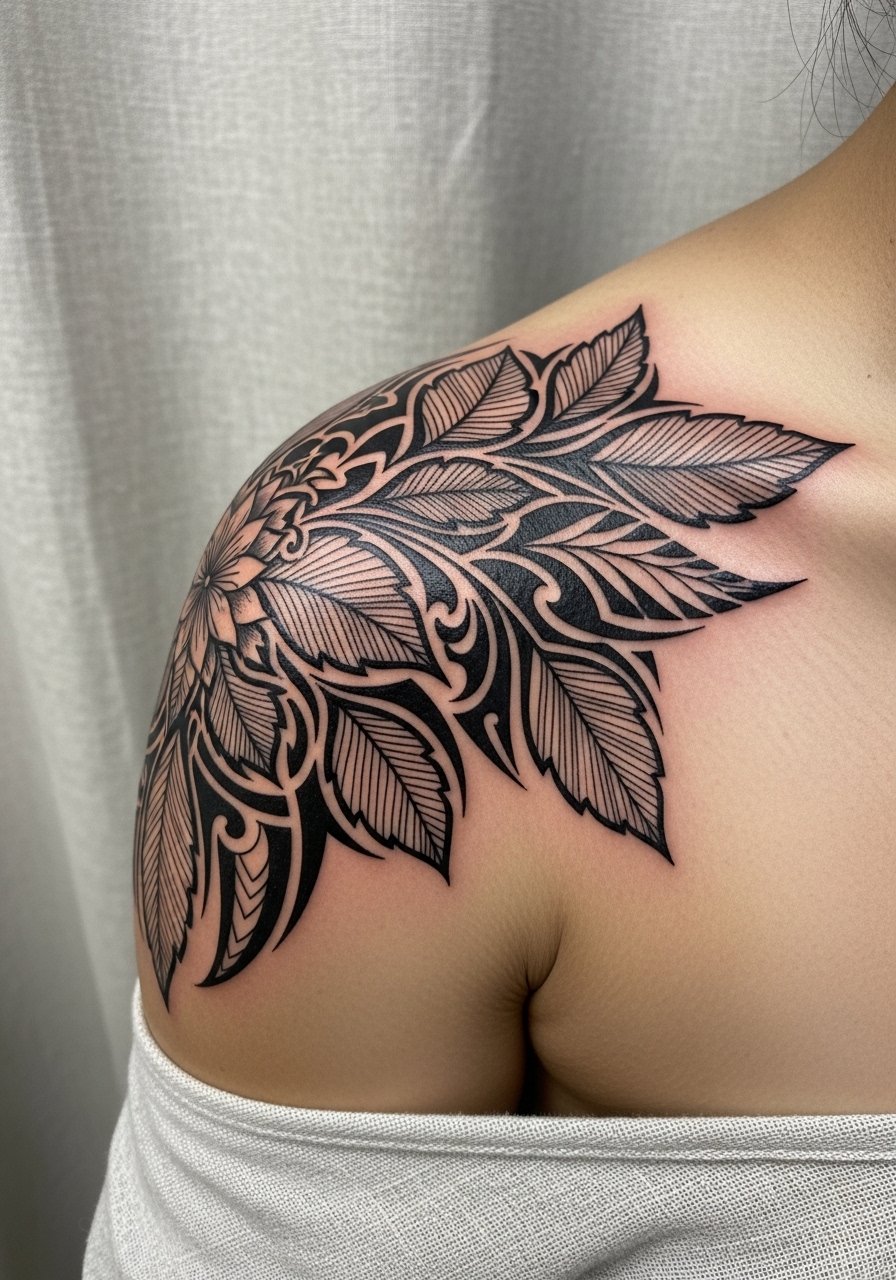
This option takes indigenous Bornean motifs and translates them into botanical panels that curve over the shoulder. It reads like armor that breathes.
Use a lightweight stencil transfer paper if you want to mock up how vines will wrap your muscle.
Style & Design Details
- Tattoo style: blackwork illustrative
- Recommended size: 4–6 inches to preserve leaf details
- Best placement(s): shoulder cap, outer back, upper arm
- Color vs. blackwork: black for clean silhouette; soft grey wash optional for depth
- Design elements: stylized leaves, vine tendrils, tapered linework, repeating motifs, negative-space highlights
- Longevity note: fine tendrils may soften; thicker structural lines hold years
- Who it suits: lovers of botanical motifs with cultural edge
Finding the Right Artist
Choose an artist who handles both fine organic linework and bold separators. Ask for healed photos of similar vine panels and how they address flow across the shoulder’s curve. Avoid those who lack examples of curved-placement design.
Aftercare & Healing Tips
Delicate lines need consistent moisturizing; switch to thin Lubriderm after the wrap phase. Keep the area out of heavy friction (straps, tight shirts) during the 2-week peel.
7. Bold Chevron Shield — tribal shoulder cap tattoo
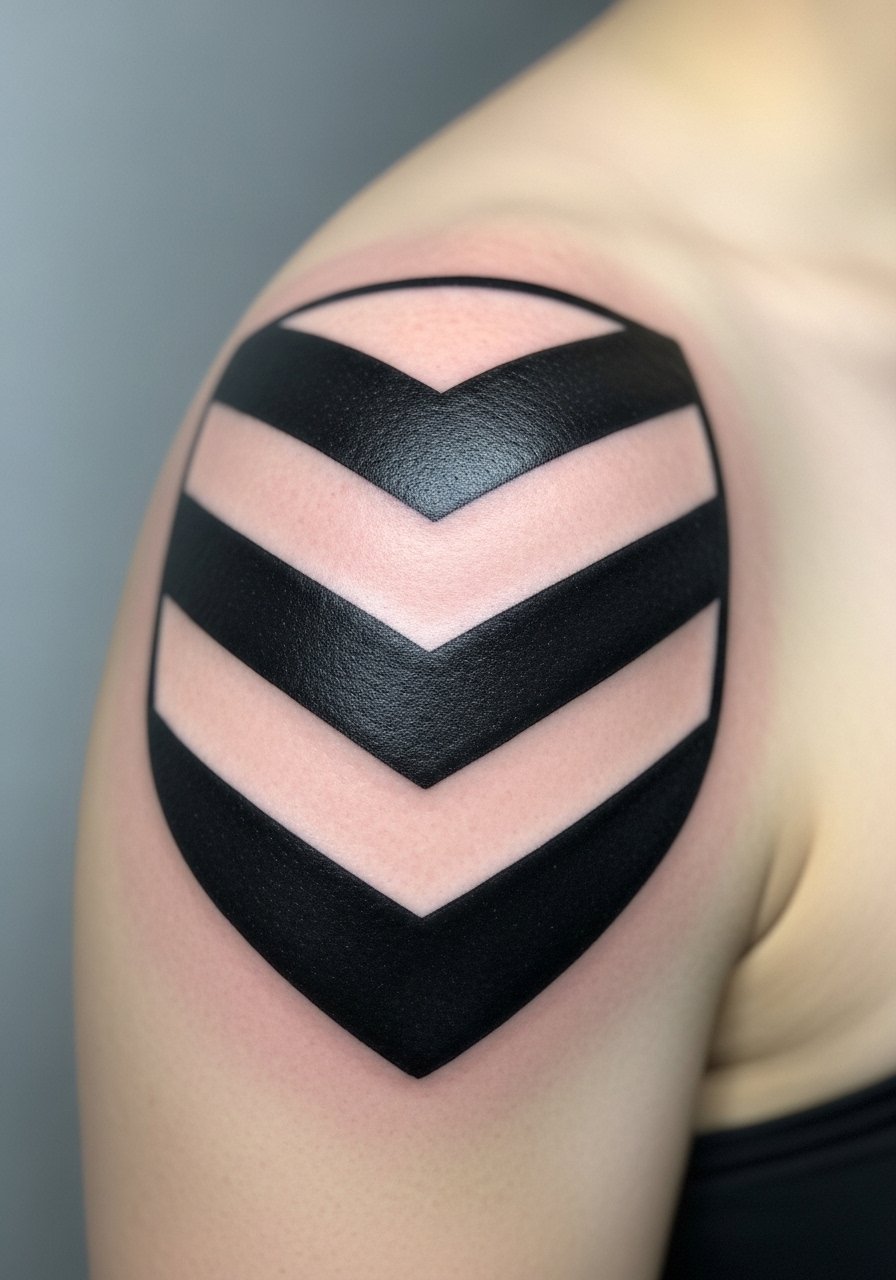
Chevron shields form a protective visual barrier across the shoulder. The staggered V shapes play with the shoulder’s bone structure to emphasize strength and motion.
A small roll of Saniderm is handy to have ready for wrap application immediately post-session.
Style & Design Details
- Tattoo style: blackwork, geometric
- Recommended size: 3–6 inches across cap
- Best placement(s): shoulder cap, outer bicep, upper back
- Color vs. blackwork: solid black chevrons recommended
- Design elements: stacked V chevrons, varied negative spaces, border bands, tapered ends
- Longevity note: geometric repetition helps mask minor blurring over time
- Who it suits: people wanting bold, graphic armor-like tattoos
Finding the Right Artist
Search portfolios for crisp geometric blackwork and healed photos with even saturation. Ask the artist how they’ll ensure straight chevrons over curved muscle. Avoid rushed freehand without a solid stencil.
Aftercare & Healing Tips
Use Saniderm initially, then a fragrance-free lotion like Lubriderm during peeling. Heavy black fills may need touch-up after 3–6 months.
8. Fine-Line Tribal Filagree
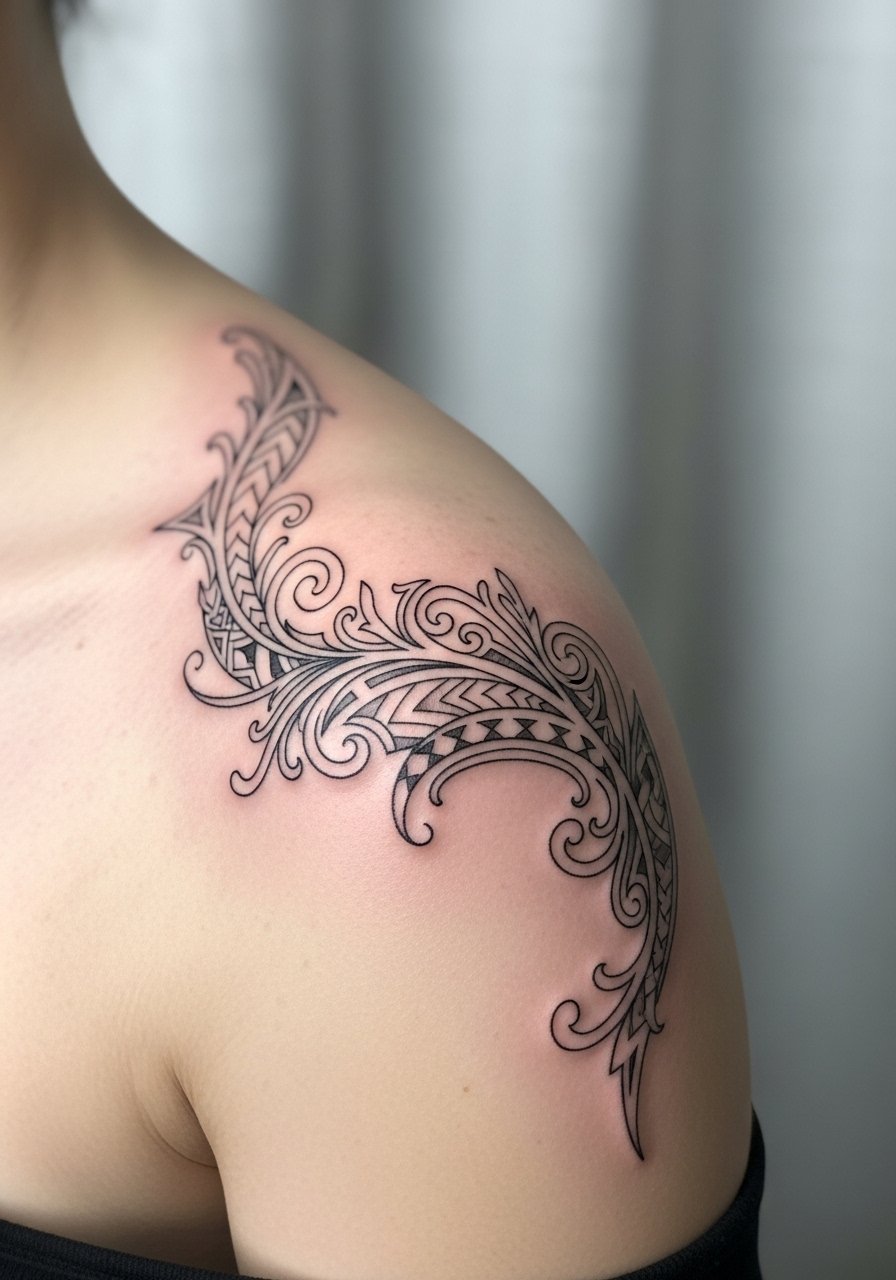
This is a modern twist: tribal motifs reinterpreted in ultra-fine single-needle lines, creating an airy, lace-like effect across the shoulder cap.
Fine-line work benefits from minimal swelling; try a small amount of EMLA cream if you’re nervous about long, precise lines.
Style & Design Details
- Tattoo style: fine line, single-needle
- Recommended size: 2–4 inches to keep lines legible
- Best placement(s): outer shoulder, collarbone edge, upper arm
- Color vs. blackwork: black fine-line; white-ink highlights optional
- Design elements: delicate swirls, micro-dotwork, thin borders, negative filigree, mirrored symmetry
- Longevity note: single-needle lines fade faster and may blur on oily skin; touch-ups likely
- Who it suits: minimalists, those cautious about heavy coverage
Finding the Right Artist
This needs a single-needle specialist. Look for portfolios with healed close-ups of fine-line work. Ask how they adjust needle grouping and depth for longevity. Avoid artists who primarily do heavy blackwork.
Aftercare & Healing Tips
Fine lines heal quickly but require SPF protection to avoid fade. Use After Inked lotion during peeling and a mineral SPF 50 tattoo stick long-term.
9. Tribal Sunburst Medallion
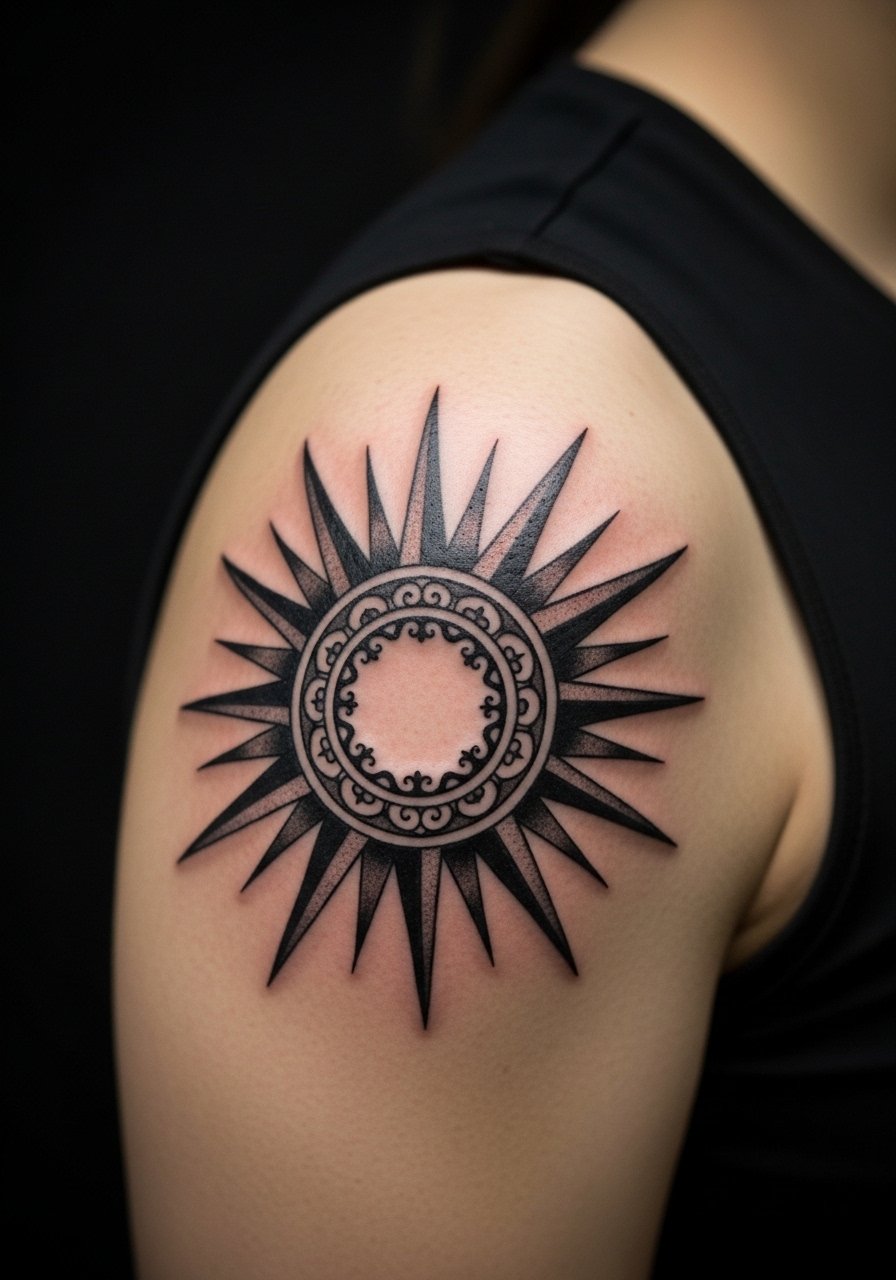
A medallion centers attention on the shoulder peak. Sunburst rays radiate across the cap, mixing solid blocks and thin separators for a striking silhouette.
Before sitting, I sometimes use a small dermaplaning razor to remove micro-hairs for a cleaner stencil; a gentle skin prep razor works well.
Style & Design Details
- Tattoo style: blackwork medallion
- Recommended size: 3–5 inches centered on shoulder
- Best placement(s): shoulder cap center, upper back, outer chest
- Color vs. blackwork: solid black with negative rings
- Design elements: concentric rings, radial rays, small dot separators, scalloped borders
- Longevity note: high-contrast radial designs age well if lines stay saturated
- Who it suits: people wanting a focal, emblematic shoulder piece
Finding the Right Artist
Pick someone who composes radial symmetry well. Bring multiple angles in consultation to discuss how the medallion sits when your arm moves. Avoid artists unfamiliar with symmetrical patterning.
Aftercare & Healing Tips
Use Saniderm for the first 48–72 hours, then gentle washing and Hustle Butter Deluxe during peeling. Keep center lines moisturized to avoid scabbing thickly.
10. Micronesian Triangle Cluster
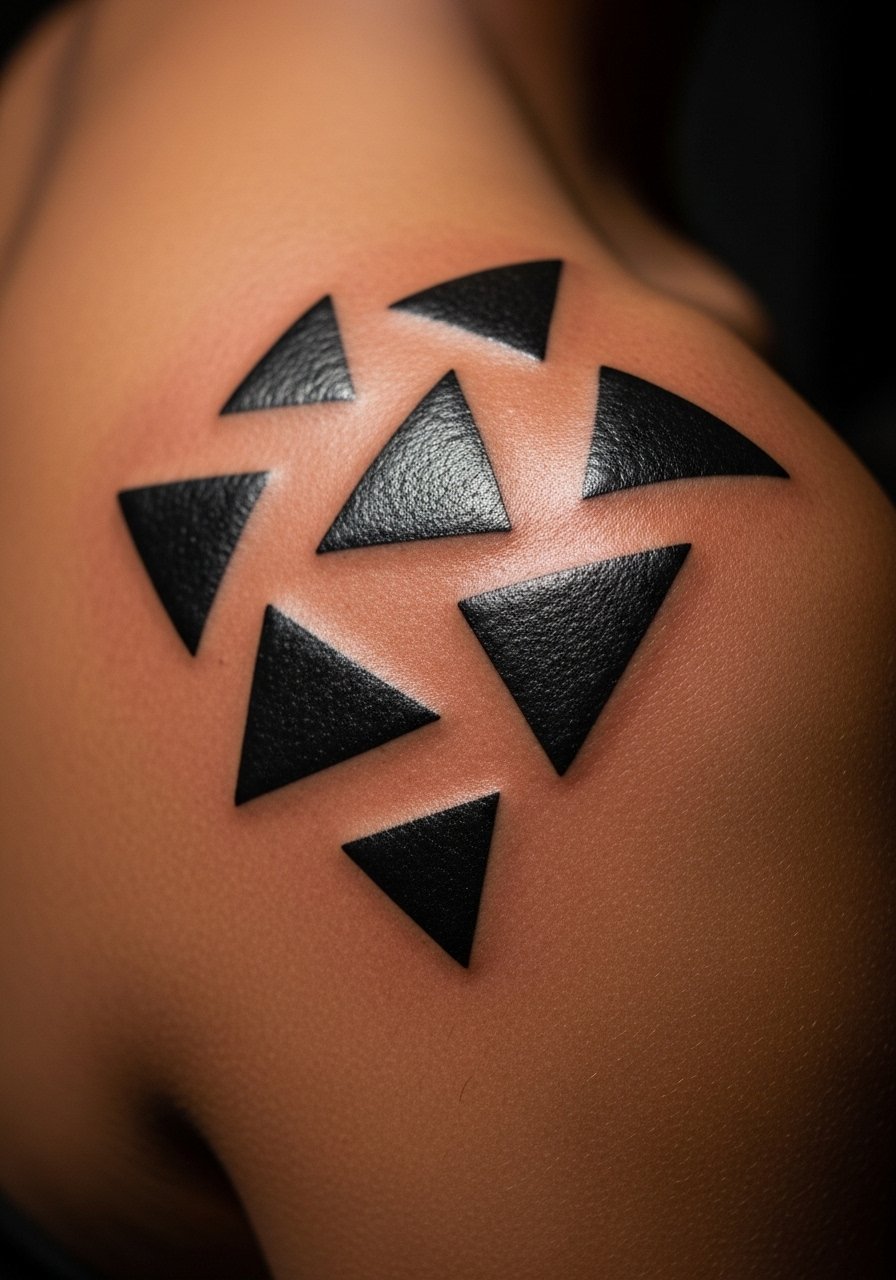
Micronesian triangles create kinetic patterns that emphasize movement along the shoulder curve. Clustered triangles with alternating fills read energy and direction.
If you’re experimenting with placement first, a semi-permanent Inkbox tattoo helps you live with the design for 1–2 weeks.
Style & Design Details
- Tattoo style: blackwork geometric
- Recommended size: 3–6 inches cluster
- Best placement(s): shoulder cap, upper arm wrap, near armpit edge
- Color vs. blackwork: solid black triangles for contrast
- Design elements: alternating filled/unfilled triangles, negative separators, angled flow, tapered endpoints
- Longevity note: triangle edges hold well when lines are deep; keep moisturized
- Who it suits: bold aesthetic fans and people who like clear silhouette tattoos
Finding the Right Artist
Choose artists with prior geometric work and healed portfolios. Discuss how triangles will distort with the shoulder’s motion. Avoid artists who can’t demonstrate consistent fill density.
Aftercare & Healing Tips
For dense black clusters, consider a Saniderm wrap for 48–72 hours and then Lubriderm fragrance-free lotion for daily moisturizing. Expect possible slight touch-ups after full settle.
11. Samoan Story Panel
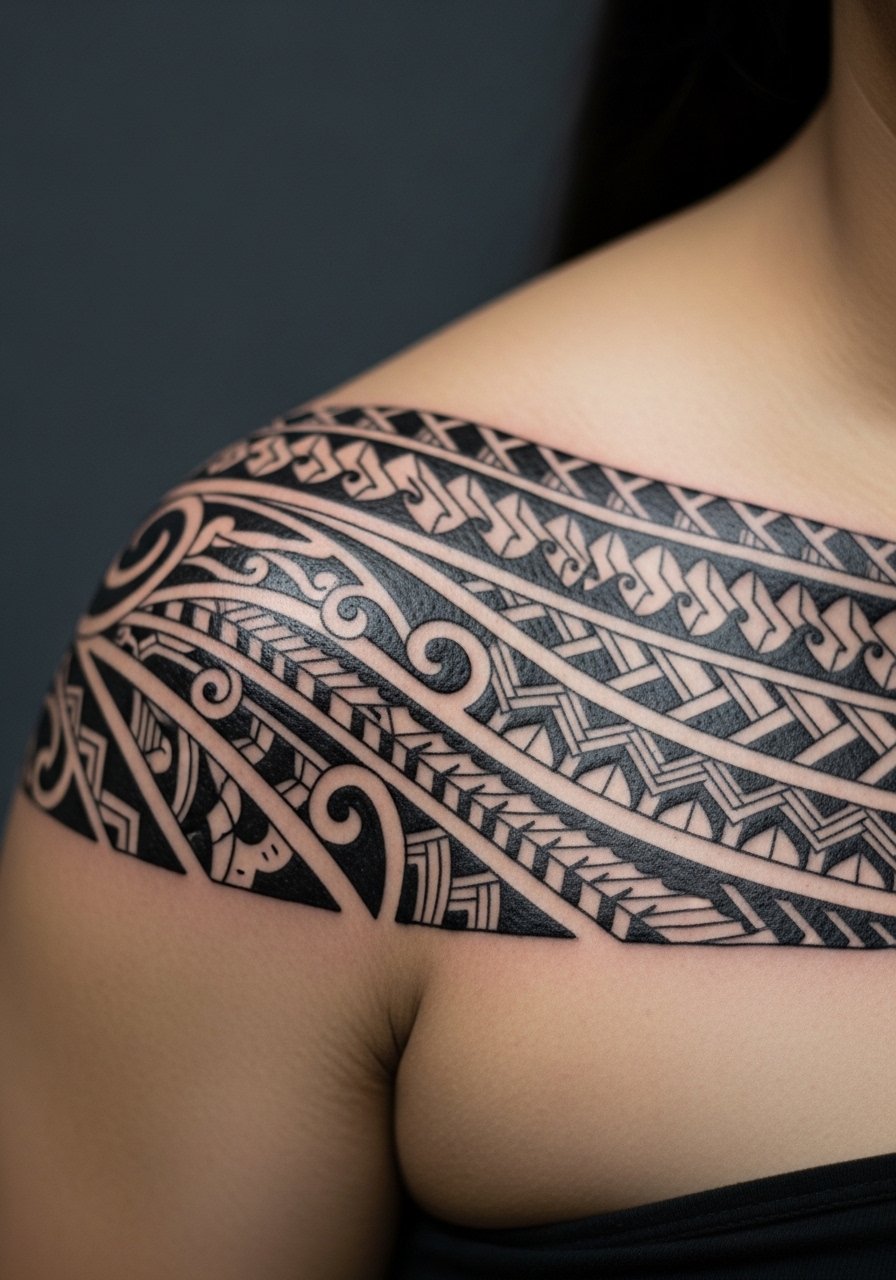
Samoan panels are narrative strips that can incorporate life milestones or family symbols. On the shoulder cap, a panel reads like a sash of story.
Bring reference photos and be prepared for a longer consult — communicating meaning is part of the process. Many artists appreciate clients who bring a basic legend.
Style & Design Details
- Tattoo style: traditional Samoan blackwork
- Recommended size: 4–8 inches lengthwise depending on story complexity
- Best placement(s): shoulder cap sash, chest transition, upper back
- Color vs. blackwork: blackwork with negative space storytelling
- Design elements: ocean motifs, spearheads, turtle symbols, concentric bands, repeating units
- Longevity note: bold traditional patterns age well when scaled for skin motion
- Who it suits: those who want culturally anchored, narrative tattoos
Finding the Right Artist
Look for artists experienced in Samoan work and respectful of cultural context. Ask about how they’ll adapt traditional units for your body and whether they’ll explain each element’s meaning. Avoid artists who replicate symbols without context.
Aftercare & Healing Tips
Because panels can be long sessions, follow aftercare with a Saniderm wrap and switch to an unscented lotion like After Inked after the wrap. Protect from sun during the first 6 months.
12. Geometric Mandala Shoulder Cap
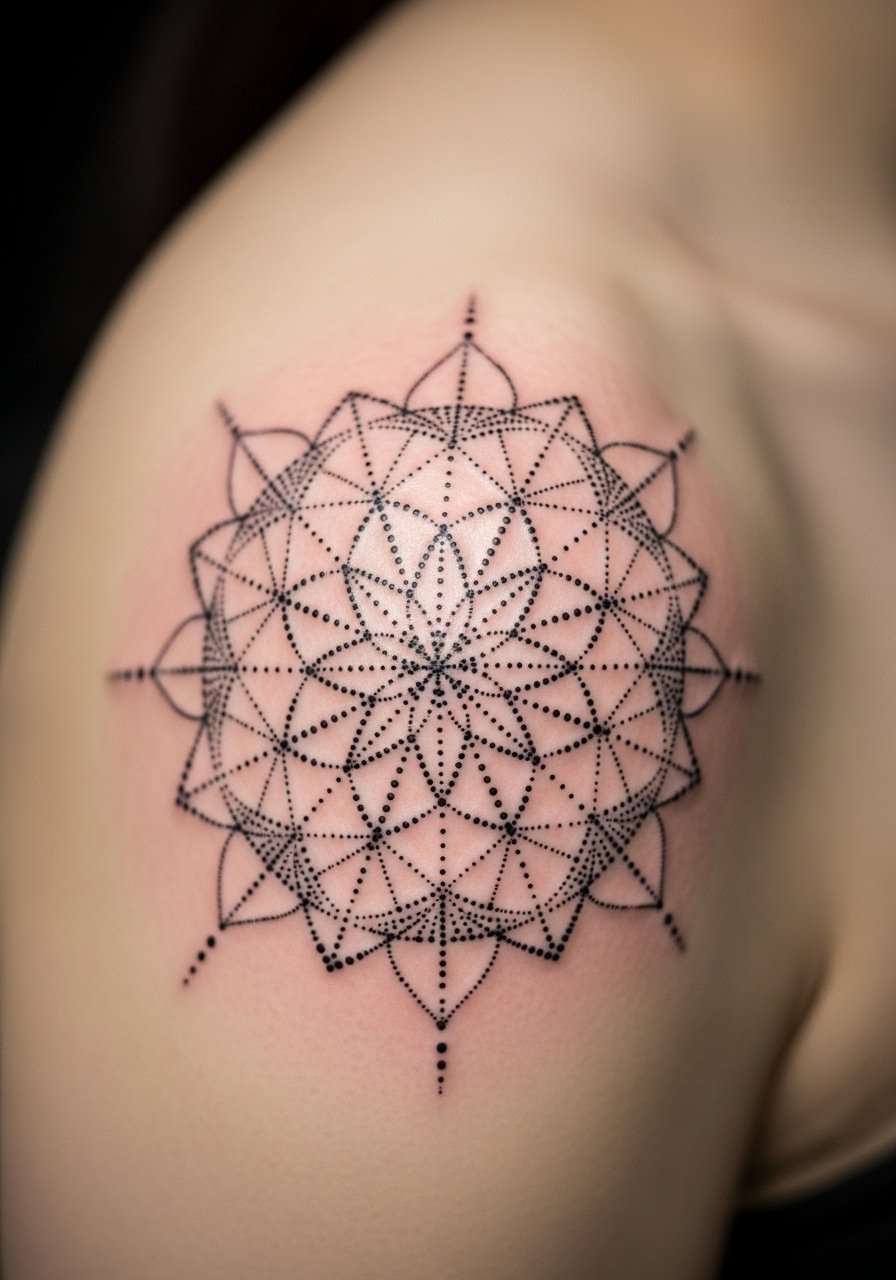
Mandala geometry feels meditative and visually balanced. On the shoulder cap it acts like a focal point with radiating symmetry.
Because of dotwork and tiny lines, ask about shorter shading passes to reduce swelling. A small pot of Hustle Butter Deluxe is good for the first weeks of moisturizing.
Style & Design Details
- Tattoo style: geometric mandala, dotwork
- Recommended size: 3–5 inches for detail clarity
- Best placement(s): shoulder cap center, upper back, outer chest
- Color vs. blackwork: black + grey dotwork for depth
- Design elements: concentric rings, micro-dot shading, symmetric petals, thin radial lines, negative cutouts
- Longevity note: dotwork can fade mildly; strong outline rings preserve shape
- Who it suits: meditative aesthetic lovers and festival-goers
Finding the Right Artist
Pick a dotwork specialist with steady hand and healed photos. Ask how they’ll space dots to limit blowout and discuss break strategy to avoid overworking skin. Avoid artists without dotwork portfolio.
Aftercare & Healing Tips
Use Saniderm early if available, then gentle washing and thin layers of After Inked during peeling. Long-term SPF is important to keep dotwork crisp.
13. Minimal Tribal Shoulder Cap Tattoo — bold line crescent
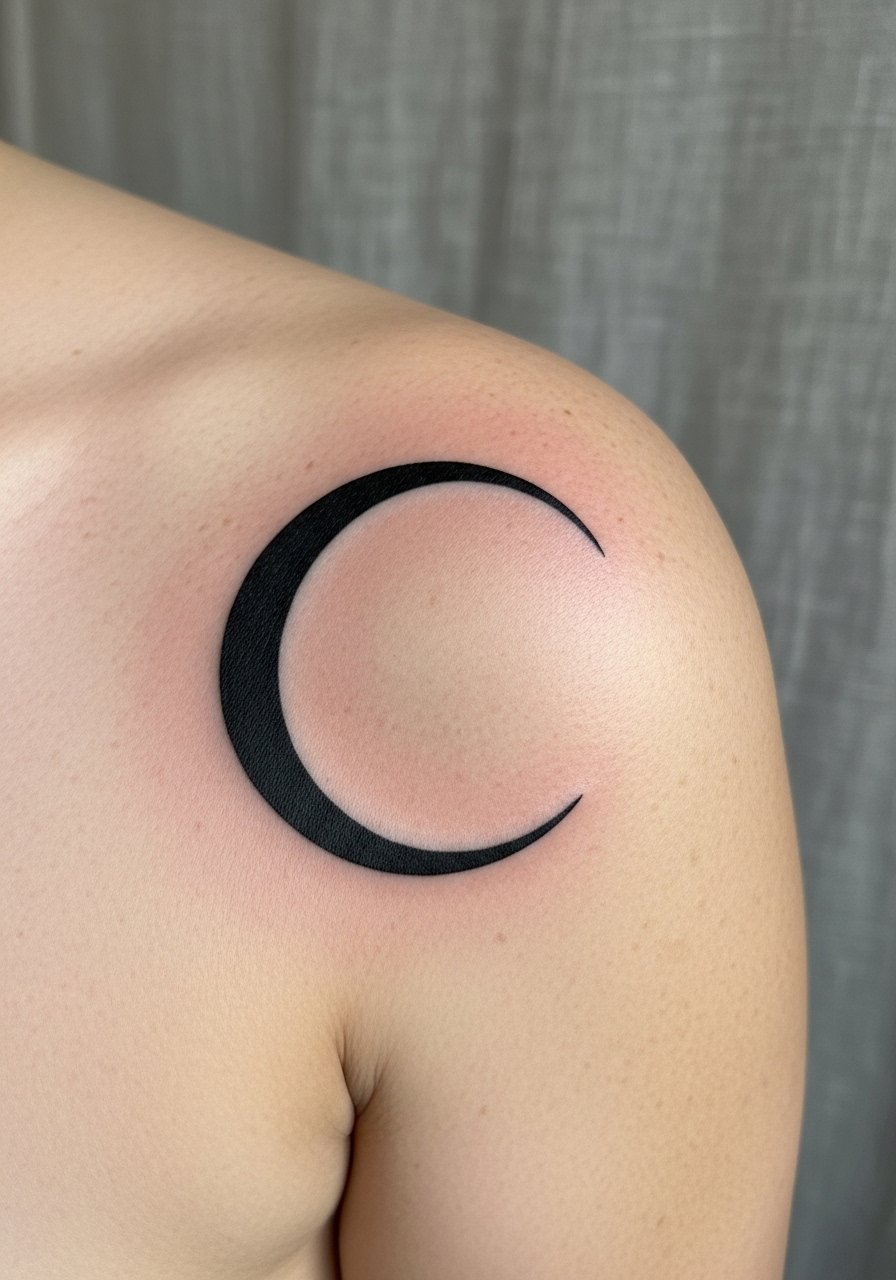
This is a stripped-back approach: a bold crescent that echoes tribal curvature without heavy fill. It reads crisp and modern, and is a great intro to tribal shoulder cap tattoo aesthetics.
If you’re trying minimal placement first, use Inkbox temporary tattoos to test visual scale for a week.
Style & Design Details
- Tattoo style: minimal blackwork
- Recommended size: 2–4 inches
- Best placement(s): shoulder cap edge, collarbone, upper arm
- Color vs. blackwork: single black line for simplicity
- Design elements: bold crescent, tapered ends, negative-edge, micro-scallop detail optional
- Longevity note: simple lines are easy to touch up; avoid very thin lines
- Who it suits: first-timers, minimalists, people wanting tribal reference without heavy saturation
Finding the Right Artist
Fine minimal lines need control; find someone with single-line portfolios. Ask about needle size and whether they prefer multiple passes. Skip artists who usually do heavy coverage only.
Aftercare & Healing Tips
Minimal pieces heal fast. Use gentle soap and a thin layer of unscented Lubriderm during peel. SPF is crucial for thin-line longevity.
14. Aztec Sunshield Panel
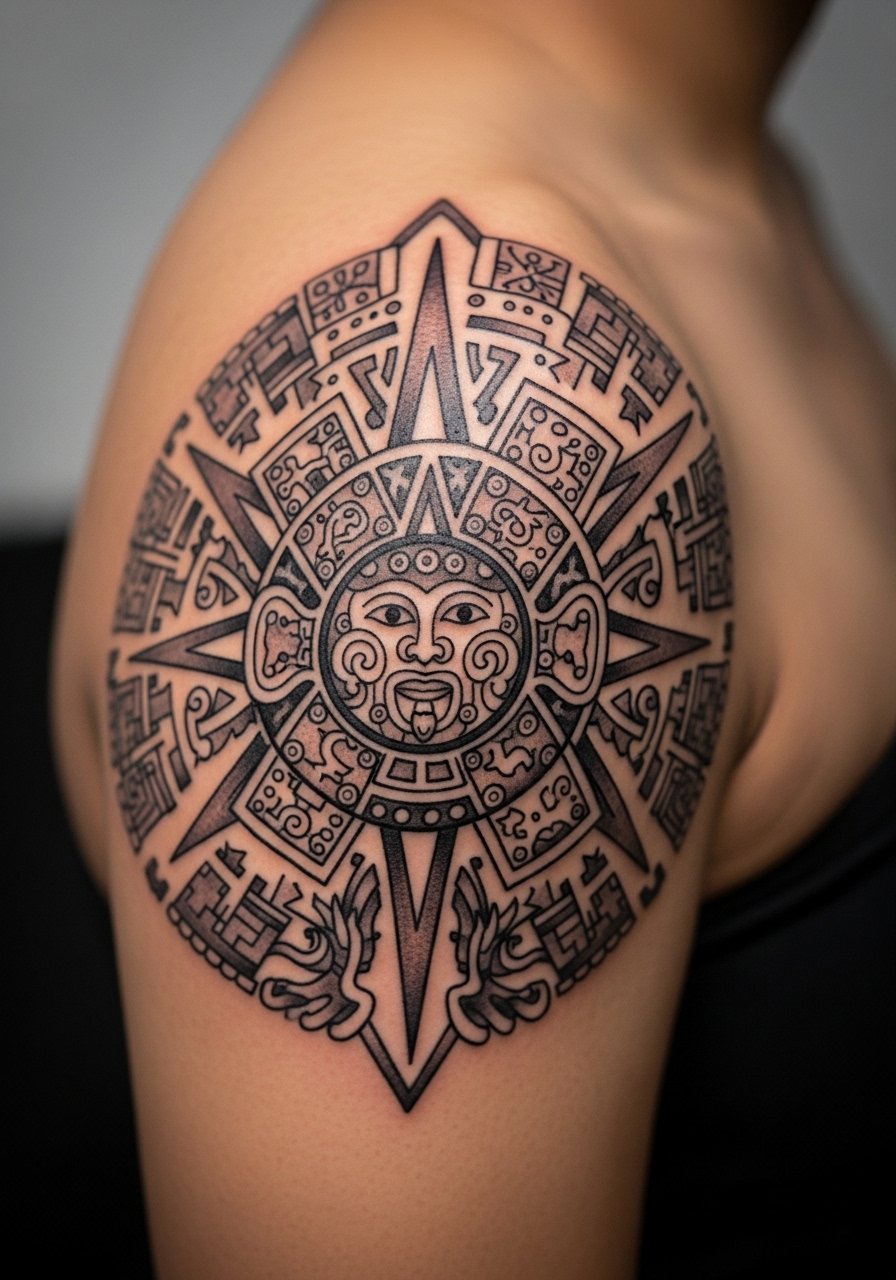
Aztec glyphs and sun motifs provide a bold historical reference. On the shoulder cap, the shield panel can curve to mirror musculature.
Bring reference books or flash; a tattoo design book or flash compendium is a useful consult tool — try searching for tattoo design books to prepare.
Style & Design Details
- Tattoo style: illustrative blackwork with glyph elements
- Recommended size: 3–6 inches
- Best placement(s): shoulder cap, upper back, outer chest
- Color vs. blackwork: solid black with decorative negative spaces
- Design elements: radial sunface, repeating glyphs, stepped borders, triangular teeth, radiating bands
- Longevity note: bold glyphs hold over time; small squared details should be scaled up
- Who it suits: history buffs and those drawn to pre-Columbian iconography
Finding the Right Artist
Select artists who can render crisp glyph shapes and show healed examples. Ask how they’ll adapt squared motifs to rounded anatomy. Avoid artists who lack geometric/illustrative balance.
Aftercare & Healing Tips
Use Saniderm, then switch to a fragrance-free lotion during peel. Keep heavy clothing off the area to avoid friction. Consider a mild touch-up after 6–12 months if small details relax.
15. Kayan Weave Shoulder Panel
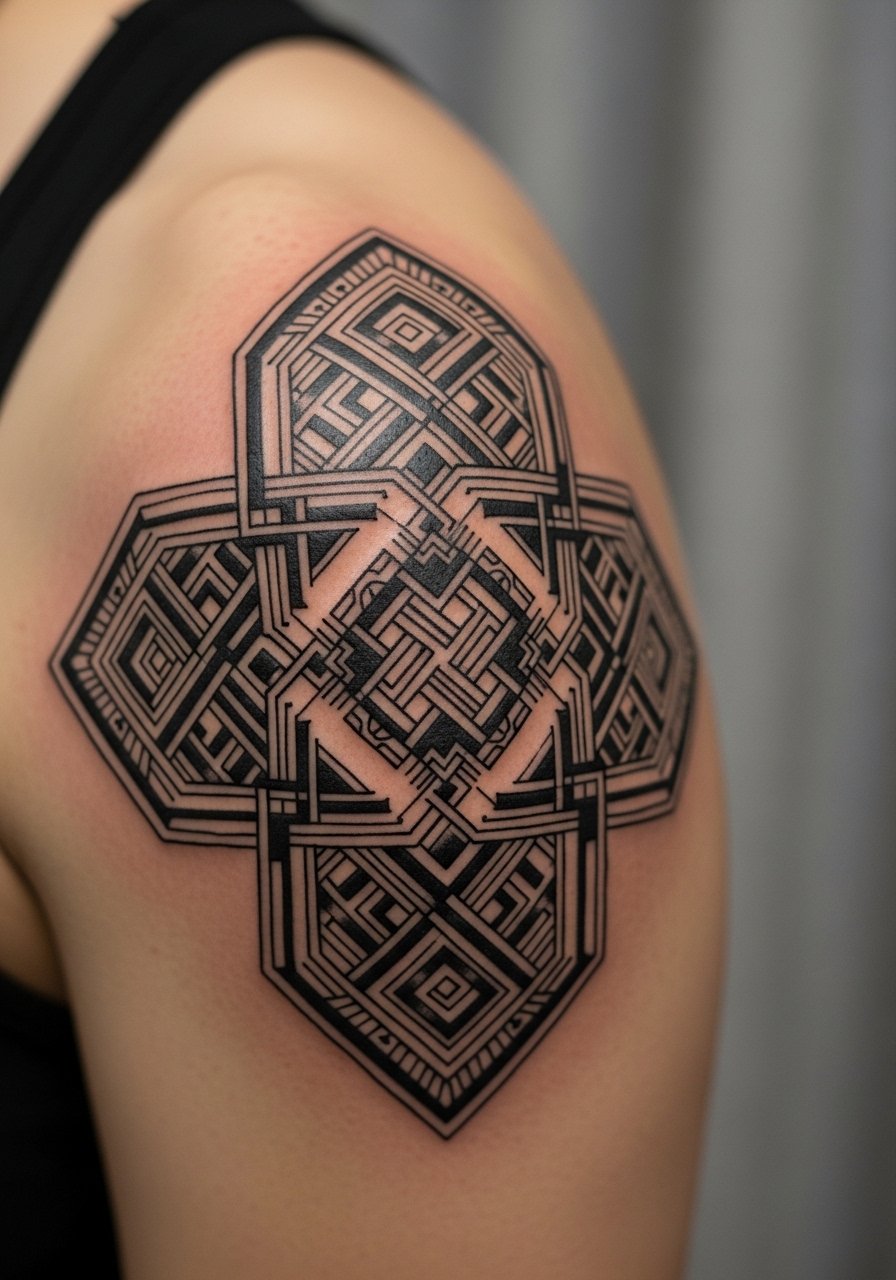
Weave patterns look like woven armor across the shoulder, with interlocking bands that imply strength and connectivity.
If the session will be long, having a legible playlist or breaks scheduled helps. I also keep a small tube of Hustle Butter Deluxe for immediate post-session moisturization.
Style & Design Details
- Tattoo style: blackwork interlace
- Recommended size: 4–7 inches
- Best placement(s): shoulder cap, upper back, outer arm
- Color vs. blackwork: black interlaced bands
- Design elements: over-under weave, tapered terminals, negative spacers, bold structural lines
- Longevity note: structural bands age well; thin interlaces may require touch-ups
- Who it suits: fans of textile-inspired ink and bold patterning
Finding the Right Artist
Find someone who composes woven negative space well and can show healed photos of interlace work. Ask about scaling so the weave remains legible on curved skin. Avoid inexperienced pattern artists.
Aftercare & Healing Tips
Saniderm for the first days is helpful. Then wash with gentle soap and moisturize with After Inked. Keep out of abrasive straps or seat belts during healing.
16. Sunken Negative-Space Chevron
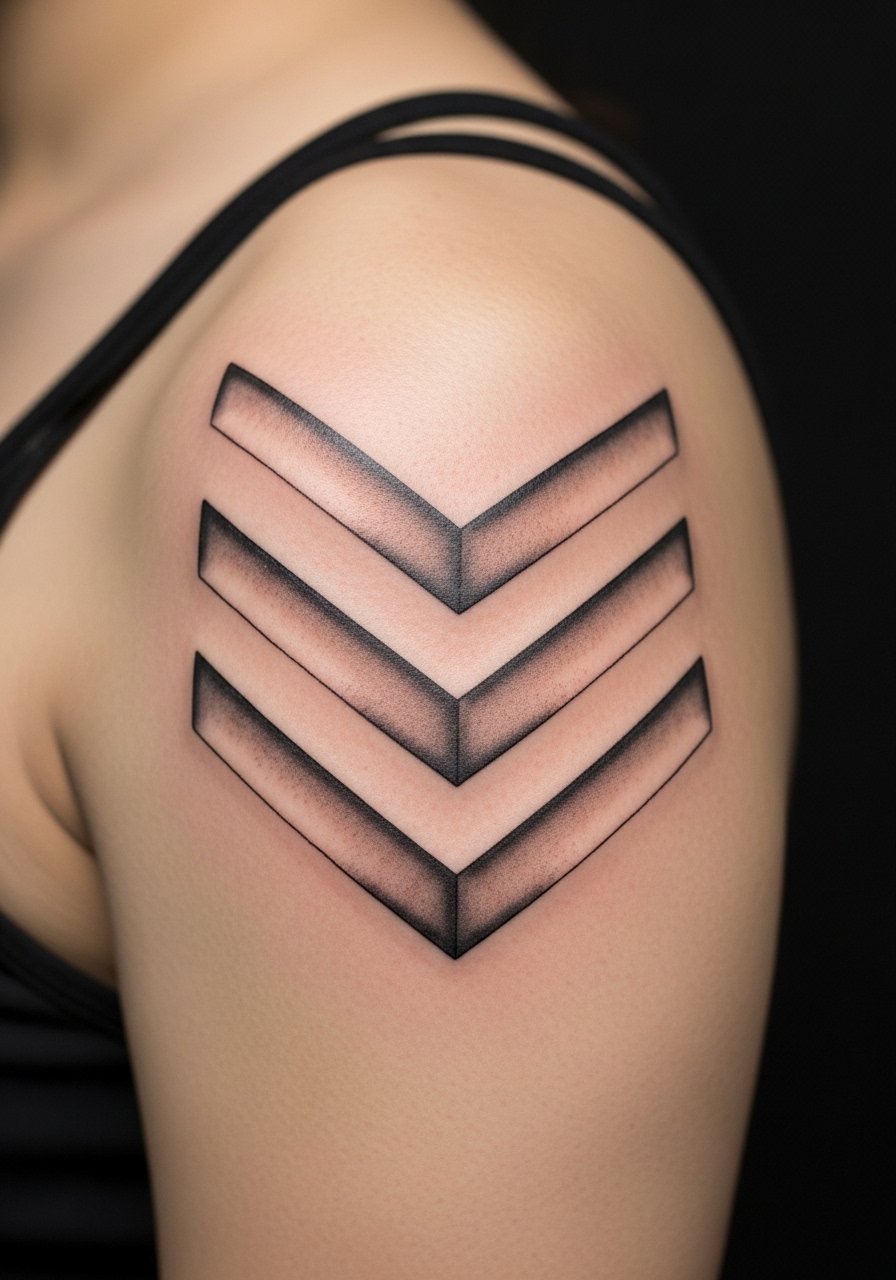
This design uses negative space to create depth. Solid black blocks frame uninked skin, making the pattern look carved into the shoulder cap.
A light stencil test is helpful; bring a tattoo placement stencil paper to try exact placement.
Style & Design Details
- Tattoo style: blackwork with negative-space carving
- Recommended size: 3–6 inches
- Best placement(s): shoulder cap, outer bicep, upper back
- Color vs. blackwork: deep solid black with strategic uninked skin
- Design elements: negative chevrons, sharp contrast, framed borders, tapered detail
- Longevity note: negative-space pieces show changes in skin tone; sun protection is crucial
- Who it suits: bold minimalists who appreciate optical depth
Finding the Right Artist
Look for artists with high-contrast portfolios. Ask how they’ll factor your skin tone into negative-space decisions. Avoid artists who can’t show healed negative-space work.
Aftercare & Healing Tips
Use Saniderm early, then switch to fragrance-free lotion. Keep out of sun and avoid tanning beds — negative-space contrast fades rapidly with UV.
17. Ancestral Knotwork Shoulder Cap
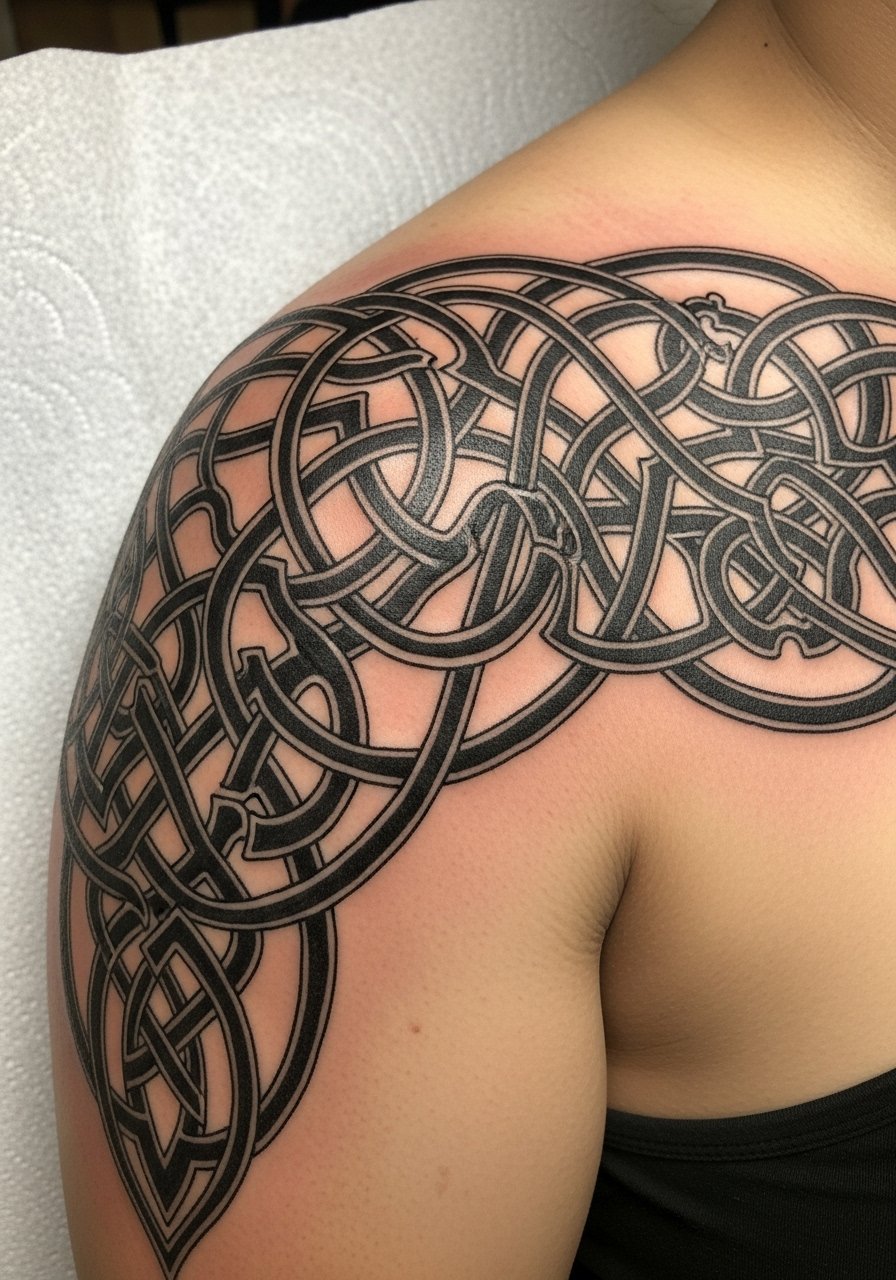
Knotwork represents continuity and ancestry. The shoulder cap is a strong canvas for interlaced knots that wrap and return.
If you plan on large sessions, a calming pre-session routine and EMLA cream can help reduce discomfort.
Style & Design Details
- Tattoo style: blackwork knotwork
- Recommended size: 4–8 inches to show knot detail
- Best placement(s): shoulder cap, upper chest, back
- Color vs. blackwork: solid black lines with negative separation
- Design elements: continuous knots, loop terminals, border bands, tapered crossings
- Longevity note: continuous knots maintain symbolism even if small lines soften
- Who it suits: those seeking lineage or continuity symbolism
Finding the Right Artist
Seek artists who have experience with Celtic or knotwork styles and can scale knots for skin. Ask how they’ll map the knot to your shoulder’s curvature. Avoid artists who can’t demonstrate continuity across movement.
Aftercare & Healing Tips
Saniderm for initial protection, then gentle cleanses and a thin layer of Hustle Butter Deluxe during peel. For long-term maintenance, apply SPF regularly.
18. Feather & Spear Mix
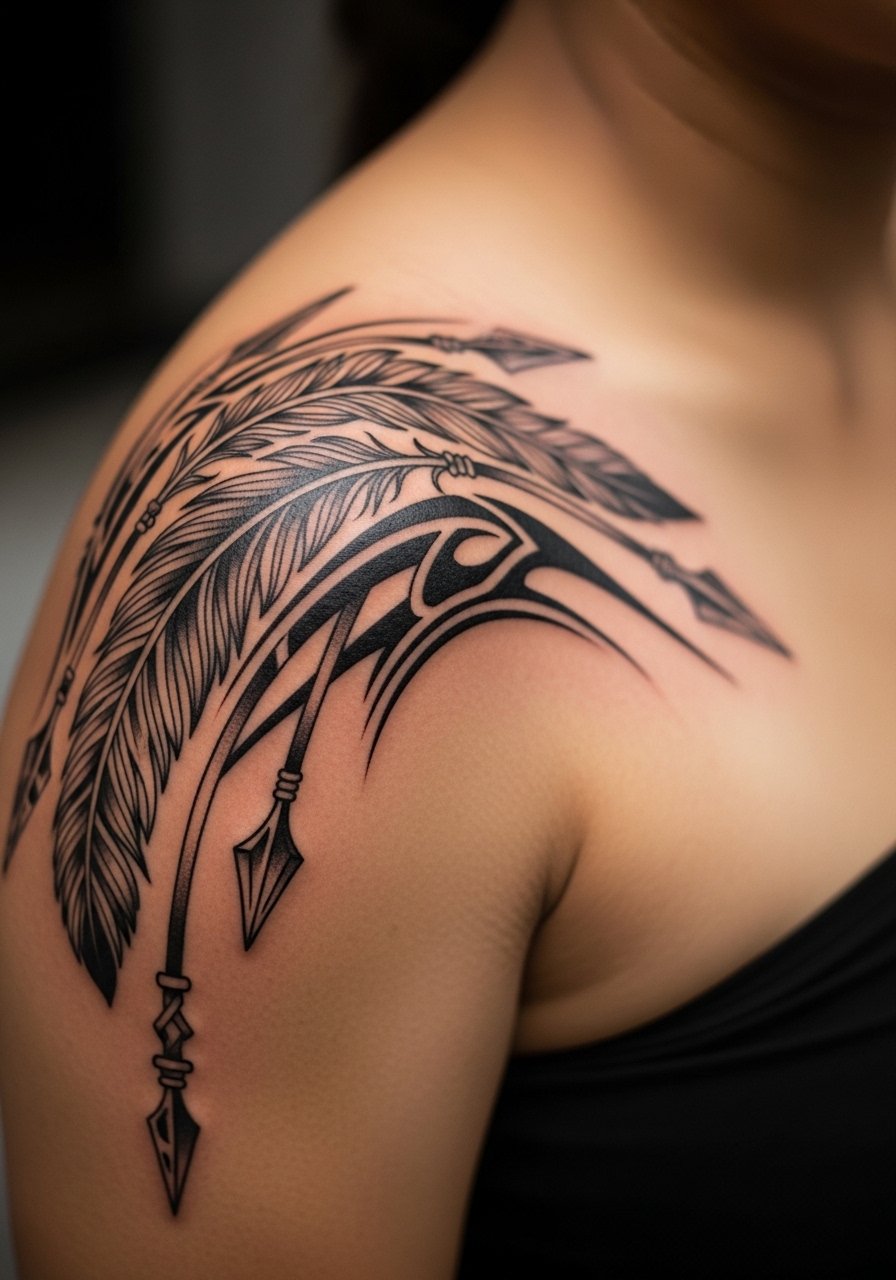
A mix of feather motifs and spearheads blends softness and edge. Feather vane lines flow down the deltoid while spearheads angle outward.
Bring sketches or reference images; apps like Procreate (iPad) help you visualize composition.
Style & Design Details
- Tattoo style: illustrative blackwork
- Recommended size: 3–6 inches
- Best placement(s): shoulder cap flowing to upper arm, clavicle edge
- Color vs. blackwork: black with thin greywash accents
- Design elements: tapered spear points, feather barbs, micro-dot connectors, flowing stems
- Longevity note: feather details are delicate; bold stems hold best
- Who it suits: people who like mixed textures and directional motion
Finding the Right Artist
Find an artist who mixes illustrative feathers and graphic spearheads in their work. Ask about needle group choices for feather vane texture. Avoid someone who only does heavily shaded realism.
Aftercare & Healing Tips
Thin feather lines need careful moisturizing; use After Inked during peeling and an SPF stick for sun protection.
19. Linear Wave Band
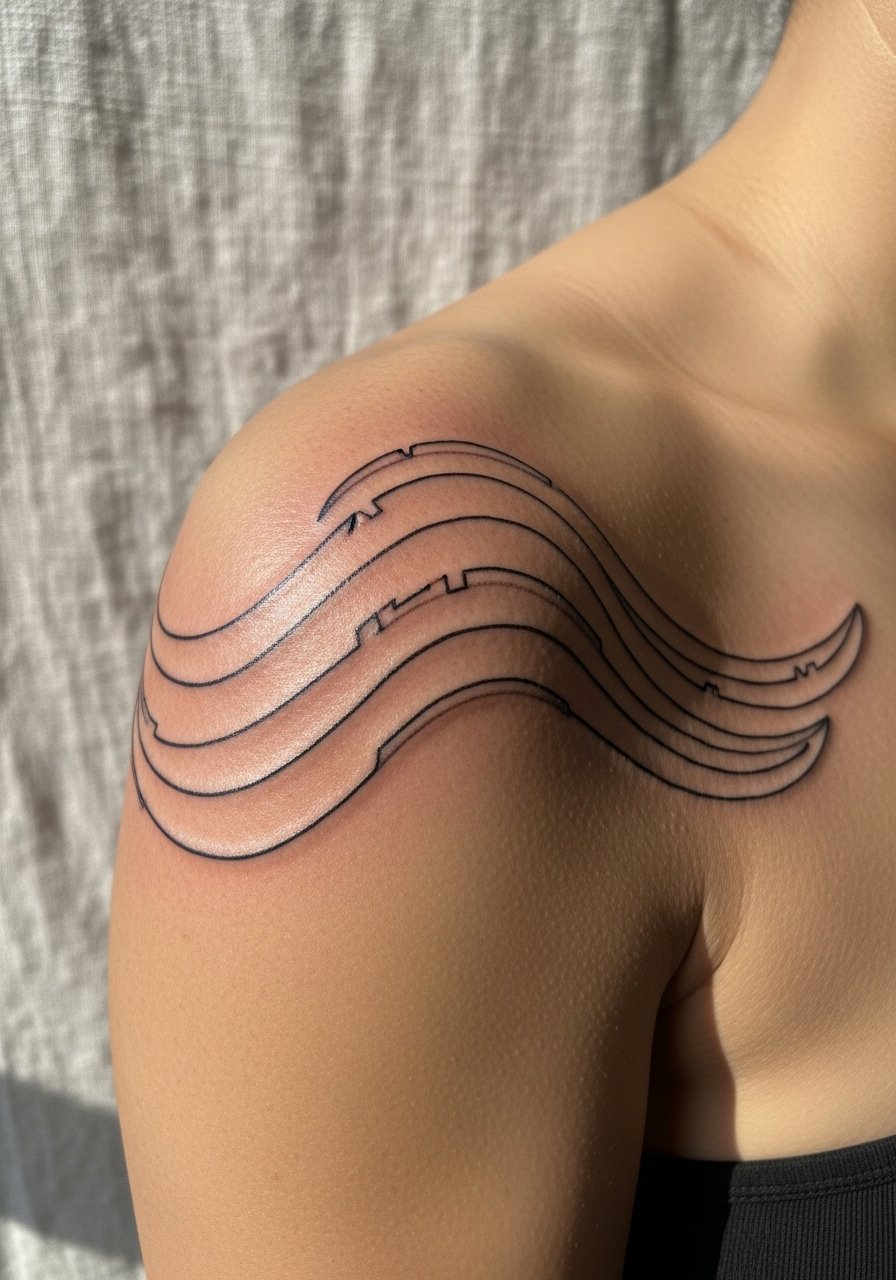
Parallel wave lines create subtle motion that hugs the shoulder’s curves. Slight breaks in the lines create rhythm and avoid heavy saturation.
Try a temporary Inkbox to test how simple bands move when you lift and rotate the arm.
Style & Design Details
- Tattoo style: minimal blackwork, linear
- Recommended size: 3–5 inches across cap
- Best placement(s): shoulder cap curve, outer arm
- Color vs. blackwork: simple black linear strokes
- Design elements: parallel waves, micro-breaks, tapered ends, negative rhythm
- Longevity note: simple lines are easier to retouch; keep moisturized and sun-protected
- Who it suits: minimalists who prefer movement over dense pattern
Finding the Right Artist
Choose an artist with steady line control. Ask to see healed photos of parallel-line work on curved areas. Avoid those whose lines wobble in portfolio close-ups.
Aftercare & Healing Tips
Follow standard Saniderm use, then thin layers of Lubriderm. If lines soften with time, a small touch-up can restore crispness.
20. Crescent Shield with Dot Halo
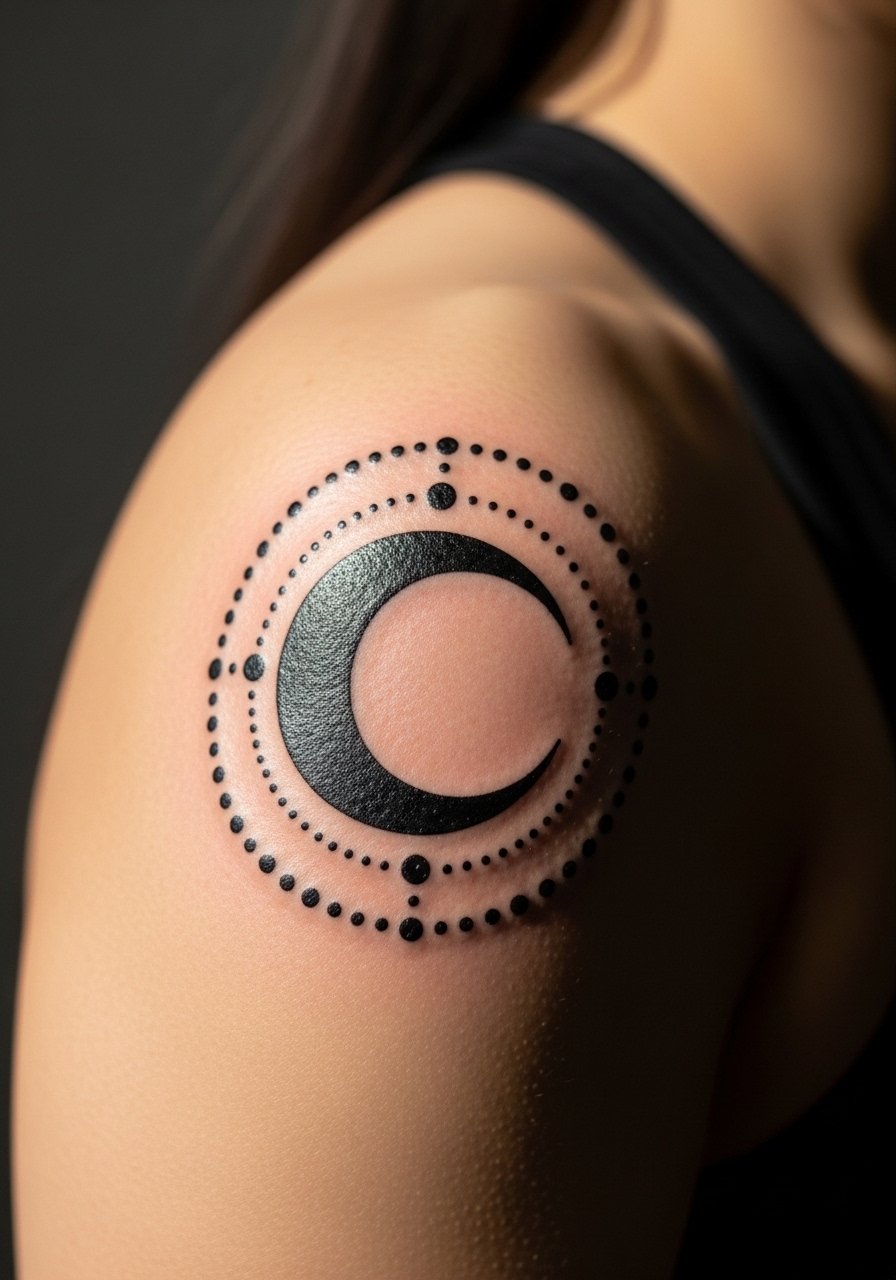
A crescent shield anchored near the shoulder peak with a surrounding dot halo feels both protective and ornate. The dot halo softens the bold crescent.
For dotwork comfort, shorter shading passes reduce swelling. Keep Hustle Butter Deluxe handy post-session.
Style & Design Details
- Tattoo style: blackwork with dotwork halo
- Recommended size: 3–5 inches
- Best placement(s): shoulder cap, upper chest
- Color vs. blackwork: solid crescent plus grey dot halo
- Design elements: crescent shield, surrounding micro-dot halo, negative separators, tapered edges
- Longevity note: dot halo may blur slightly; strong crescent preserves focal point
- Who it suits: people who want bold focal shapes with decorative texture
Finding the Right Artist
Look for work that shows smooth dot gradients and solid focal shapes. Ask about spacing between dots to reduce blowout risk. Avoid inexperienced dotworkers.
Aftercare & Healing Tips
Saniderm early, then gentle washing and thin After Inked during peeling. Long-term SPF keeps halo contrast visible.
21. Modern Tribal Geometry Collar Transition
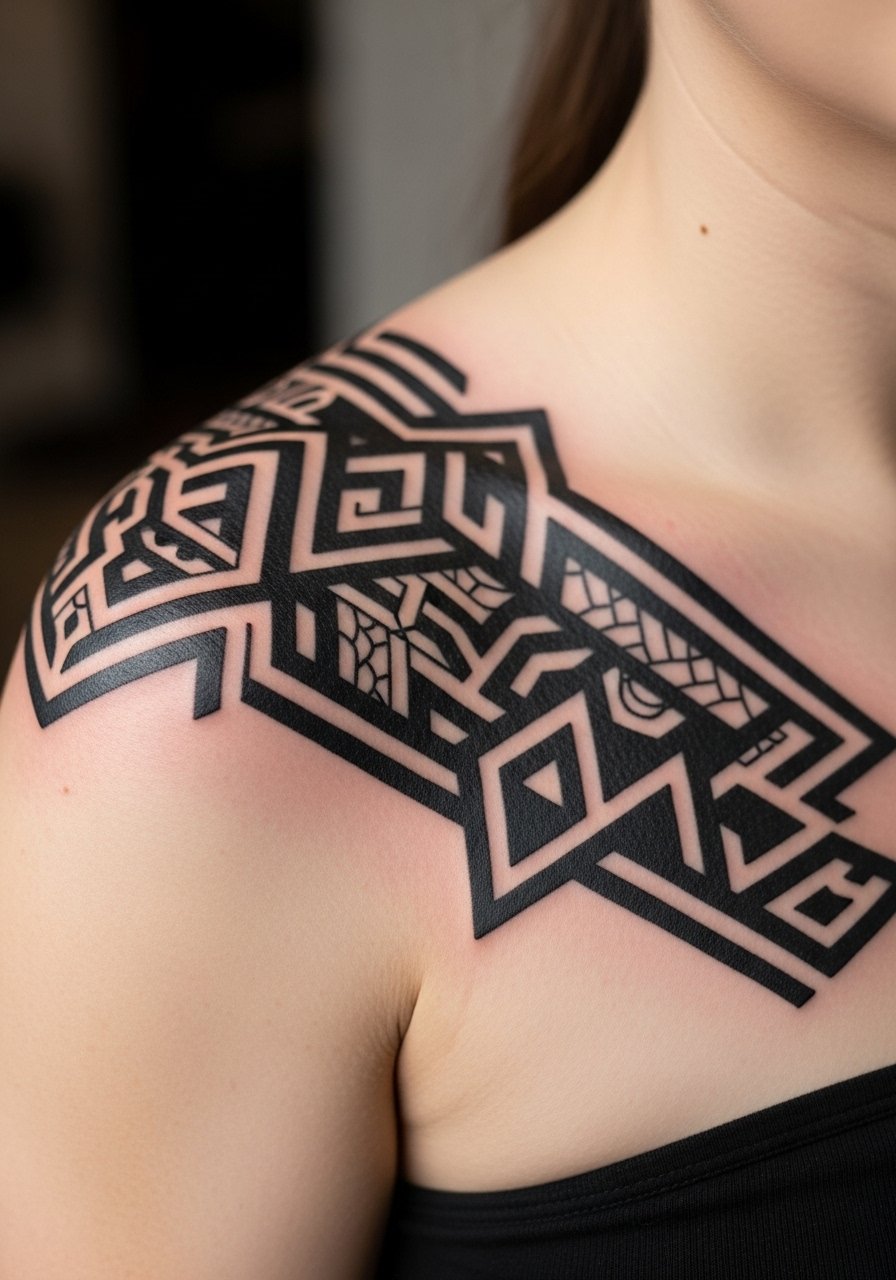
This transitional design links the shoulder cap to the collarbone, making a statement across multiple planes. Interlocking geometry modernizes tribal language without heavy fill.
For precision, bring a sketch or use an iPad with Procreate to show rhythm and flow to your artist.
Style & Design Details
- Tattoo style: modern geometric tribal
- Recommended size: 4–8 inches spanning cap to collarbone
- Best placement(s): shoulder cap to collarbone, upper chest, shoulder to neck transition
- Color vs. blackwork: solid black lines and negative geometry
- Design elements: interlocking polygons, collar transitions, tapered connectors, border edges
- Longevity note: cross-plane designs require strong outlines to hold across movement
- Who it suits: avant-garde tattoo lovers and those wanting a statement connector piece
Finding the Right Artist
This is placement-sensitive; choose someone who plans stencils on-body and shows healed cross-plane works. Ask how they’ll adapt for posture and shoulder roll. Avoid artists who sketch without body testing.
Aftercare & Healing Tips
For larger transition pieces, use Saniderm for the first 48–72 hours, then wash and moisturize with Lubriderm. Keep the area out of heavy sun and reapply an SPF stick when outdoors.
You’ve just scrolled through 21 different takes on the tribal shoulder cap tattoo — from dense Polynesian shields to minimalist crescents and dot-haloed crescents. There’s a lot of room between full black armor and single-line subtleties, and you can mix motifs to make something personal. Save the images that speak to you, bring a note about what the symbols mean to your consultation, and ask to see healed photos; that tells you more than flash ever will.
Honestly, having a small aftercare kit ready before your appointment—Saniderm for the first days, a fragrance-free lotion like Lubriderm, and a tube of Hustle Butter Deluxe for weeks two and three—keeps you calm and prevents scrambling after heavy sessions. Which shoulder cap style are you leaning toward? Is it the heavy blackwork shields, a fine-line filigree, or a symbolic koru spiral? Pin this to your inspiration board and bring a couple of favorites to your artist — they’ll love the clarity.